
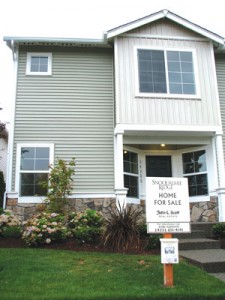
There was no question that Harry Oestreich, Snoqualmie’s finance director, had the undivided attention of the city council.The meeting was called specifically so Oestreich could brief the council on the city’s budget picture, and to give a clue or two as to what the panel would have to grapple with during it’s budget discussions for 2009.
And the picture Oestreich drew was not pretty.
“Our economy is driven by one industry – the home construction industry,” Oestreich said. “We are in a housing crisis, and everybody is agreeing there is no bottom yet.”
Oestreich said that while Washington typically lags behind the rest of the nation in terms of economic trends, projections clearly show the city will soon face some hard decisions in its fight to attain “sustainability.”
Because of the city’s reliance on new home sales, predominantly in the Snoqualmie Ridge developments, certain projections – such as when a “build out” would be achieved – must now be reworked, he said.
The slowdown, Oestreich said, extends the build out from what was once assumed to be 2012 “to as much as 2116 to 2119, depending on the economy.”
Such data amounts to a double whammy on the city’s treasury, he said. Because projections were for houses to sell faster, at would had been very high values, the city had anticipated receiving greater revenues more rapidly than it now appears possible.
Compounding the problem is that, as new construction slows, so has the value of homes, meaning that homes that will not come on line for several more years may likely do so at a reduced price than in the past, representing even less tax revenue for the city.
In his presentation, Oestreich said housing sales locally were at their lowest levels since 2003, with new construction being down the most since 2006.
Recent figures obtained by Washington State University’s Center for Real Estate Research bear out Oestreich’s assertions.
King County housing sales have dropped 12.2 percent in the second quarter of 2008, a trend experienced every quarter going back through 2007. The second quarter drop represents a 36.4 percent decrease over the same quarter in 2007.
The new figures also note that the county’s median resale price of $450,000 – second highest in the state behind only San Juan County – has fallen some 4.3 percent.
The Center’s numbers show just how elastic home prices have been in King County. The median resale price in the first quarter of 2008 was $435,000, compared to $440,000 in the first quarter of 2007. That figure jumped to $470,000 during the second quarter of 2007, $472,000 during the third quarter and back down to $439,000 in the fourth quarter.
According to figures provided by the Northwest Multiple Listing Service, 1,632 residences, including condominiums, went on the market in July 2008, compared to 1,668 in July 2007. Pending sales for July 2008, however, registered only 730 compared to 1,105 in July 2007, representing a 33.94 percent decrease.
All of which is bad economic news to a city that derives about one-half of its general fund revenues from property taxes, and underlines Oestreich’s message that the city must continue to find ways to diversify its revenue sources.
“My message was that, since we don’t have a strong sales tax (revenue source) or retail commercial center, if we have to increase revenues, we’re going to be looking at a property tax increase,” he said.
Recent developments, such as the announcement that Rudolph Technologies, Inc., has leased 27,000 square feet of space in the Kendall Lake Building in the Snoqualmie Ridge Business Park, help the city, Oestreich said.
Such openings, he said, typically represent jobs for area residents, and further opportunities for money to work into the city’s revenue stream, but pale in comparison to the potential of retail establishments.
The Rudolph Technologies move, however, in this case is simply a relocation from Issaquah, with officials citing the “lower rents, location and amenities” as the principal reasons for the move.
Another firm, Technical Glass Products, will be relocating from Kirkland to the business park, and is expected to be operational this fall.
Other already established organizations in the park include Philips Oral Healthcare, Nuprecon, T-Mobile, Zetec and the Inception Group.
“While commercial, non-retail sales tax businesses are great for job growth,” Oestreich said, “and their employees buying stuff in town, we derive less from them than we do retail associated businesses.”
Reach reporter Ed Farrell at [email protected] or 392-6434.
Filed Under Local News