
The interrogator Joseph Crecca nicknamed “The Agent” began speaking.
Speaking of how American Air Force pilots like Crecca had attacked the Vietnamese. How Vietnamese blood had been shed. And how the Vietnamese were “determined to fight and win.”
Then, American F-105 planes flew above their heads. And the speech screeched to a halt. Unlike The Agent, who fled, screaming.
Crecca, a Valley resident for 12 years, remembers and laughs. Some villain, he thought.
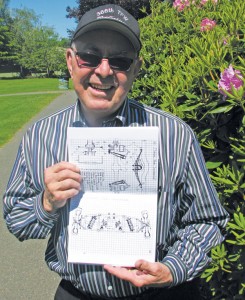
“People ask me what kept me going,” said Crecca, a Vietnam prisoner of war for six years who spent three months at the camp known as the Hanoi Hilton. “I had four pillars: faith in God, country, family and self.”
He also had a key fifth pillar: sense of humor.
A mechanical engineer and the son of Italian-Americans, Crecca inherited the brains and sense of humor from his folks.
Both would come in handy in Southeast Asia.
“We were in survival school in the Philippines, and they had these locals called Negritos,” he recalled. “And we were told to hide. If the Negritos found you, they would get a 100-pound bag of rice for each of us.”
Advantage, Negritos. They found them all and collected 13,000-plus pounds of rice.
“You got city boys in the jungle with the jungle boys,” said Crecca, who had attended college in Newark, N.J. “They knew where to go, they knew where we would hide.”
Shot out of the sky
Crecca arrived in Da Nang, South Vietnam, on Aug. 14, 1966. One hundred days later, a Soviet surface-to-air missile shot down his F-4C Phantom.
From the back seat and over the shoulders of pilot Scotty Wilson, Crecca could see things were serious.
“All I could see were the bad lights, the amber and the red ones,” he said.
The engine was on fire, as well.
Crecca said he thought, “It’s all over,” but then Wilson yelled, “Get out!” before disappearing.
When his chute opened, Crecca could see the wreckage below and later the locals waiting. He also saw Wilson.
“I knew something was wrong. His head was down and his arms were down,” Crecca said.
When Wilson’s chute had opened, a second missile had hit him.
Crecca saluted an unconscious Wilson one last time and fell among peasants who beat him, stripped him down and held him captive for hours in wintry weather before sending him bound and blindfolded to Hanoi.
“That’s when the fun and games began,” he said.
Building a mental university
At the Hilton’s main prison, Hoa Lo, he disoriented and infuriated his captors with one-liners.
Some of the captors were interested in the speed of an F-4.
“I would tell them it was much faster than the MiG 21,” Crecca said.
They roped him, neck to wrist to ankles, and slammed his body against the ground. The second time, Crecca realized it was on purpose, so he took the slams with different shoulders, to minimize the damage.
After the torture and the interrogations stopped, they moved him to a solitary room for eight months.
“I realized I had nobody to talk to, nothing to read,” he said. “I realized I had to keep myself busy. I would learn the presidents in order, then the states alphabetically, then the capitals.”
Then he would solve physics problems in his head.
“It took me two weeks to make it through the 37 steps in my head” of the problem, he said. “When I had something to write with, it took me three weeks.”
After eight months, he got roommates. So he started memorizing the names and ranks of his roommates. At one point, he knew 252.
He invented nicknames for the other guys. The Agent for the travel agent-wannabe, Gyro Gearloose for the nutty one, Spot for the one with the scar, Dilligaf for the one with the emotionless face, Dum-Dum for the dimwitted captor, Dr. StrangeGlove for the camp medic who only wore one.
After the Vietnamese herded the POWs in groups of 45 to 50, Crecca and others began teaching the group. Physics, math, calculus, social studies, auto mechanics. Even cuts of meat, wine selection and classical music, without instruments.
“We whistled and hummed,” he said, adding that one-third of the group taught something.
Using paper and a stolen ballpoint refill, Crecca wrote math and physics books. He drew engines, pistons, pumps, with no room for error. The Hanoi Hilton carried no Wite-Out in those days.
Sometimes, he would write on the back of transmissions, “Made in Italy.”
Students used a broken roof tile as chalk. With all of the erasings, the floor became “cleaner than it had been in 100 years,” Crecca said.
He had one math textbook, in Russian. He would try a problem, check the answer and slowly decipher the language.
‘Out of SAM range’
He knew little about America anymore, mostly from Vietnamese magazines photos of American pilots and use of terms like “B-52.” That meant the fight continued.
Then, in February 1973, his fight ended.
“I am not a fatalist, but I didn’t allow myself to think it was over until it was over,” he said.
His excitement grew with each movement of his plane taking off for America. But he had not been in a plane in five years, and the last trip remained fresh in his memory. He did not let himself relax until the plane was 25 miles away from the coast.
“Because then we were out of SAM range, and I felt a little bit better,” he said with a wink.
Even at home, the Vietnam milestones continued for Crecca. Twenty years to the day they got shot down, in 1986, he eulogized the remains of Scotty Wilson, finally repatriated.
And this year, he had a reunion with former fellow POWs in Arizona.
Still, a return to Southeast Asia is out of the question for him.
“Why would I waste good vacation money on a place with constant power failures, where the rats were the size of cats?” he said, while wearing a baseball cap with the name of his squadron from 1967.
Determined to fight and win?
Memories abound, good ones and the other kind. Just like back then, he relies on humor.
“It was a real boon to being there,” he said. “If you maintained your sense of humor, you could use it to help you get through the very harsh situation you were in. It was like the oil that lubricated the bearings.”
His bearings are well-lubricated and all accounted for. He followed his career in the Air Force with years as a commercial pilot, before retiring in 2005.
“I do nothing now,” he said, before reconsidering. “Wait, I talk to journalists.”
Long since remarried (“you have to write, ‘he remarried the same year I was pooping my diapers,’”) he has rebuilt his life, first in Bellevue and then in North Bend, where he moved to escape urban sprawl. These days, the only agents he talks to are the travel kind. When they give speeches, they don’t pause in fear of a 737 flying over.
“‘Aaaaa! American airplanes!’ he screamed,” Crecca remembered with a grin. “Determined to fight and win, my ass.”
Scholarship created in former POW’s name
Joseph Crecca’s class at Bloomfield High School has created a scholarship in his honor, another accolade for one of the class’ most distinguished alumni.
“I consider him our hometown hero for what he did for our country,” said Marion Reynolds Leonard, a member of the class.
Scholarships will give $500 to a student with a record of outstanding academic achievement and a commitment to higher education, she said. The first recipient will be Nicole Couto, a Bloomfield High student bound for Montclair State University in New Jersey.
The scholarship shows the class of 1958 cares about the younger generations, Reynolds Leonard said, and wants to see them succeed.
“In order to succeed, you have to have higher education and that goes right along with Joe’s philosophy,” she said. “You gotta keep learning.”
Crecca praised his former classmates, calling the class of 1958 “absolutely unique.”
“They have a luncheon every year, we went on a cruise,” he said. “You will never find another class like this one.”
Filed Under Local News